Which ticket to choose
Free entry
€0
Best for:Anyone walking past who just wants to see the instruments
- Access to the Versari collection
- Wall panels in Italian and English
Venice Music Museum + Audio Guide
from €7
Best for:Anyone who wants to understand how a violin is built
- Entry to the Music Museum
- Audio guide on Italian violin making
Venice: Classical Concert by Interpreti Veneziani + Music Museum & Audio Guide
from €37
Best for:An evening at San Vidal with the daytime background to go with it
- Concert in the Chiesa di San Vidal
- Museum entry
- Audio guide
Music Museum & Baroque Concert
from €42.50
Best for:Anyone who also wants the conservatoire hall inside Palazzo Pisani
- 90-minute concert
- Music Museum
- Digital audio guide to the city
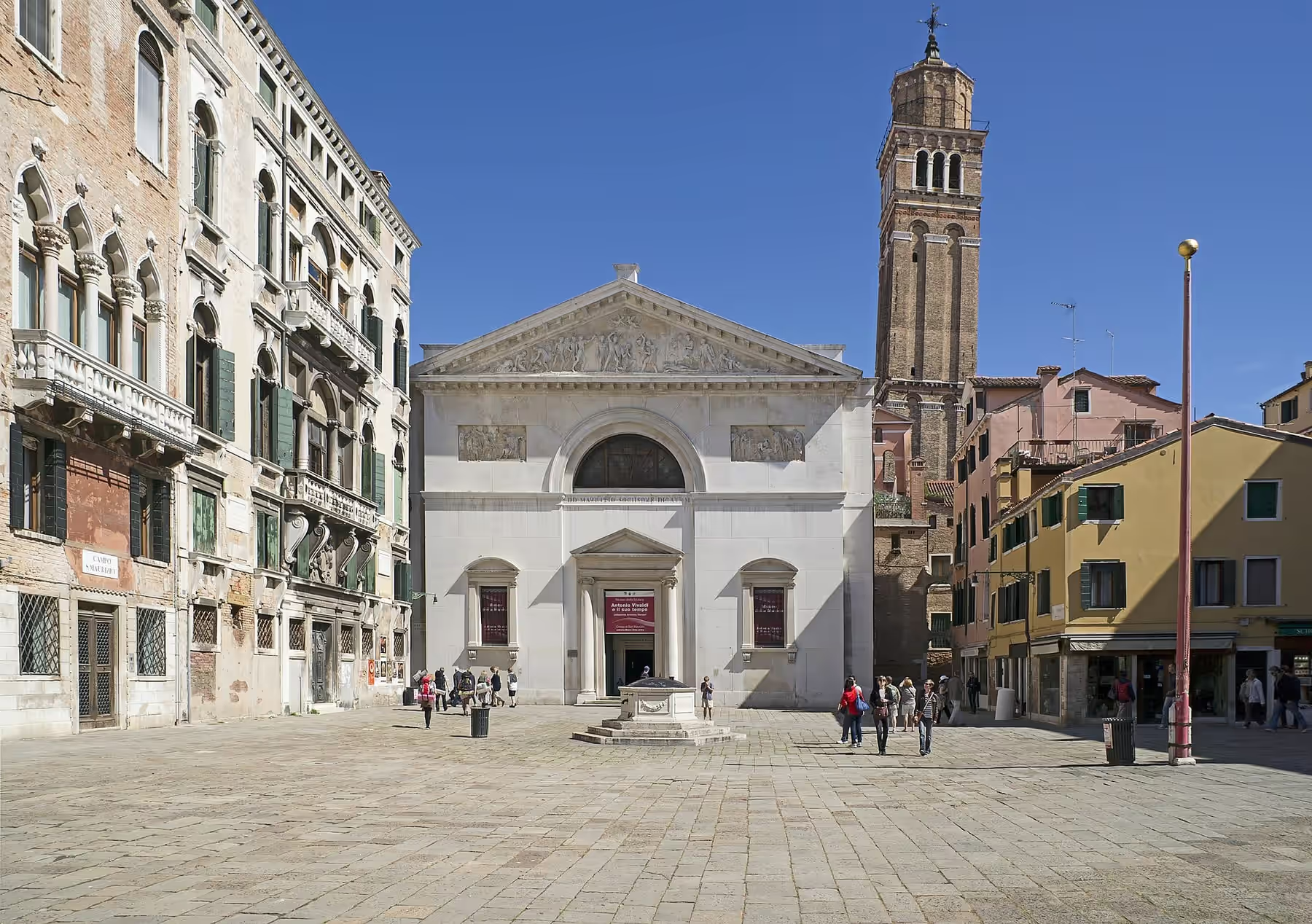
The Music Museum in Venice sits in the nave of the deconsecrated church of San Maurizio, halfway between Teatro La Fenice and the Accademia bridge. Entry is free, no booking is needed and the whole thing takes twenty to forty minutes: one of very few good things in central Venice that cost nothing at all. Inside is the violin-making collection assembled by the master craftsman Artemio Versari, run by the Interpreti Veneziani, the string ensemble that also sells tickets for its evening concerts from the same room.
What you see inside
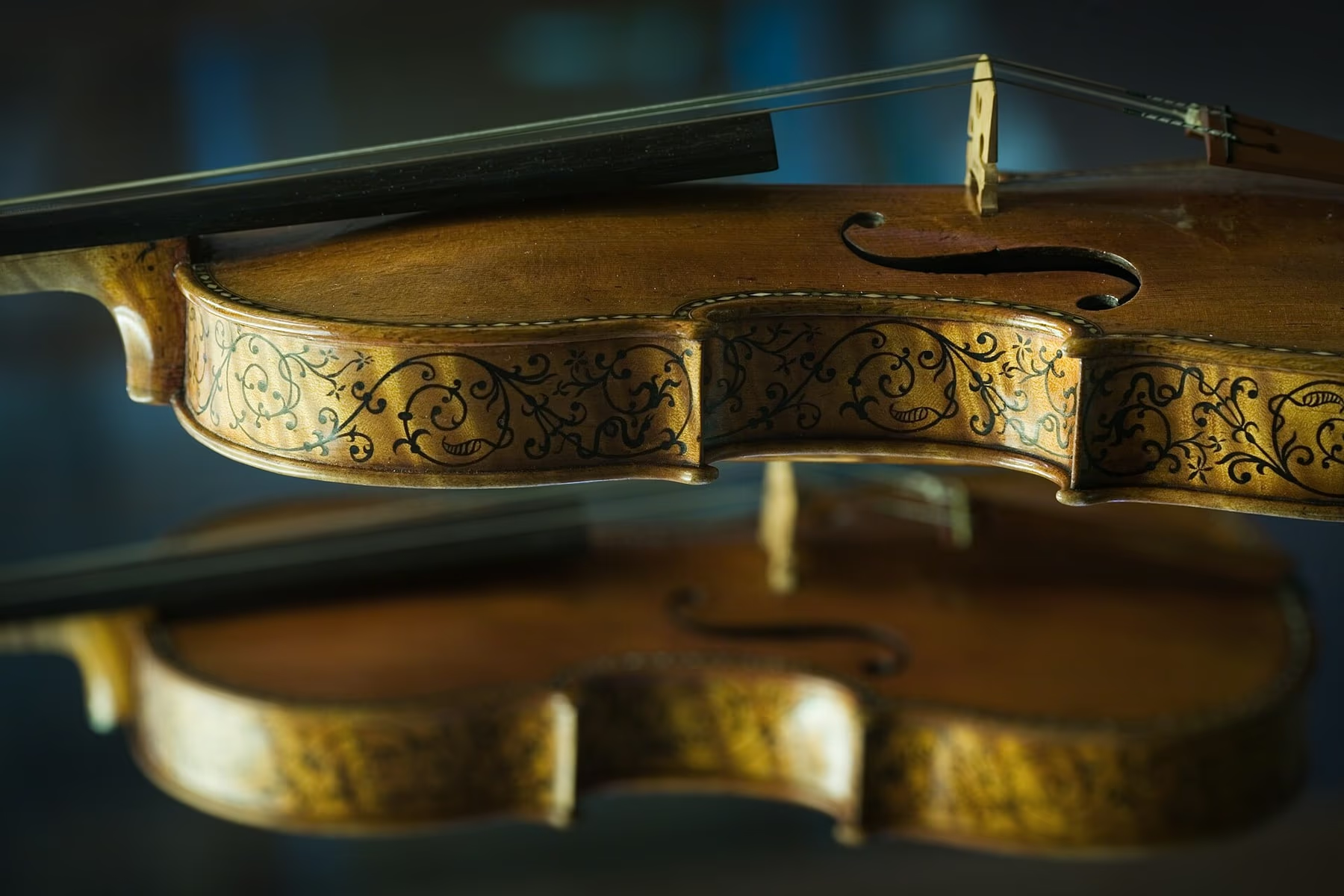
The collection comes in two halves. The first, "Antonio Vivaldi and his time", rebuilds the sound world of eighteenth-century Venice: the instruments a composer like Vivaldi actually had to hand when he was writing for the players of the Ospedale della Pietà, the orphanage that trained its girls as professional musicians. The second, "The Great Italian School of Violin Making", moves workshop by workshop and city by city — Cremona, Brescia, Venice, Milan, Naples — showing how the same object changes shape, arching and varnish depending on who builds it.
The cases hold violins, violas, cellos, double basses, a few mandolins and some wind instruments, around two hundred pieces in all. Next to the finished instruments is the part nobody usually shows you: templates, internal moulds, bass bars, bridges, bodies opened up halfway. That is why this museum works even for people who do not play. You grasp that the belly is spruce and the back is maple not because a label says so, but because the two woods are lying side by side in front of you.
The church itself is part of the visit. San Maurizio was rebuilt in neoclassical form in the early nineteenth century to a design by Giannantonio Selva and Antonio Diedo; Selva is the architect of Teatro La Fenice, three minutes away down the calle, the narrow alley that passes for a street here. The result is bright, plain and acoustically alive: if you happen in while someone is rehearsing, that alone justifies the detour.
Do not expect long labels. The panels are brief and bilingual, which is exactly why the audio guide earns its keep.
Tickets compared
The museum is free, so the real question is not which ticket but how much context you want to buy around it. There are four options and they cover different situations.
Free entry is enough if you are already walking towards the Accademia and want twenty minutes indoors. No ticket, no queue, no time slot.
The audio guide — "Venice Music Museum + Audio Guide", from €7 on Tiqets, with the same thing available at the desk for about €5 — is the right call if you care how an instrument is put together and not only what it looks like. It covers the makers' techniques, the difference between the Cremonese and the Venetian school, the reasoning behind particular varnishes. Without it, a lot of the cases stay beautiful and mute.
The combo with the Interpreti Veneziani concert ("Venice: Classical Concert by Interpreti Veneziani + Music Museum & Audio Guide", from €37) is the best seller and the most sensible choice if you have only one evening in Venice: museum in the afternoon, baroque concert at San Vidal that night, audio guide included. The concert on its own starts at €32, so the museum and audio guide are added for a few euros.
Music Museum & Baroque Concert (from €42.50) swaps in a ninety-minute concert and adds a digital audio guide to the city plus access to the concert hall of the Benedetto Marcello conservatoire, inside Palazzo Pisani. Worth it if the palace interests you as much as the music.
Book with instant confirmation


When to go
The best moment is early afternoon, between 14:30 and 16:00. That is when Campo San Maurizio empties out, because the tour groups are at St Mark's or already queueing at the Accademia, and the nave is left to five or six people. Light comes in through the high windows and the cases stop reflecting: if you want to photograph the instruments, this is the hour.
Avoid the half hour before the lunchtime closure: staff start shutting the room and there is no time for the audio guide to be any use. Avoid heavy rain between 11:00 and 13:00 too, when the museum turns into a free shelter and fills far beyond what its floor area can take.
It opens every day, Sundays and public holidays included, roughly 10:00–13:00 and 14:30–19:30. It closes or shortens the day when it hosts rehearsals, recordings or private events: one call to +39 041 2411840 on the day settles it. In December and at Carnival it often stays open through lunch, because visitor numbers double.
Acqua alta, the tidal flooding that hits the city in autumn and winter, is a minor issue here: Campo San Maurizio is not among the lowest points in Venice and the church stands a few steps above the campo.
The smart way in
There is no second entrance, but there is a clever way to use the place. The museum doubles as the physical box office of the Interpreti Veneziani: if you are undecided about the concert, walk in for free, look at the instruments, ask at the desk what is being played that evening and decide with the information in hand rather than off a screenshot. The staff know the weekly programmes better than any web page.
Second trick: the Chiesa di San Vidal, where the concerts are held, is at the opposite end of Campo Santo Stefano, five minutes away. Do the museum at 18:00, walk out, cross the campo, and you are at the concert door without going back to your hotel. Put an aperitivo in between and the evening organises itself.
Third: if you travel with an instrument, or you are a music student, ask about the guided visit by arrangement. It is not advertised on the booking platforms and has to be agreed by phone, but it is the version in which the collection genuinely opens up.
How to save
Entry is already zero, so the savings sit in how you combine things.
- Buy the combo, not the two pieces separately. Concert alone from €32, combo with museum and audio guide from €37: five euros for an audio guide that costs five at the desk. Even money, but with the booking already made.
- Concessions on the concert, not on the museum. The Interpreti Veneziani charge a reduced rate for under-25s, students and over-65s, a few euros below the full price. Online platforms usually do not show that band at all: if you qualify, the box office is cheaper.
- Do not buy two audio guides. One between two works fine: the tracks are short and you can listen shoulder to shoulder.
- The mistake that costs you: turning up in Campo San Maurizio expecting the concert to be there. It happens a lot, and it means arriving late at San Vidal. The museum and the concert hall are two different addresses.
- The Music Museum is not part of the civic museums' Museum Pass or of the Venezia Unica passes: since it is free, there is nothing for a combined pass to recoup.
One note on the contributo di accesso (Venice access fee): on the days the council applies it, day visitors who are not staying overnight pay it separately at cda.ve.it. It is a city rule, not a museum one, and no ticketing platform can sell it.
Getting there
Address: Chiesa di San Maurizio, Campo San Maurizio, San Marco 2603, 30124 Venice.
By vaporetto: the nearest stop is Santa Maria del Giglio (line 1), about 4 minutes on foot: get off, take Calle del Piovan north, cross the canal and you are in the campo. Alternatively Accademia (lines 1 and 2), 6 minutes: from the bridge head towards Campo Santo Stefano, then right.
On foot from St Mark's Square: 8–10 minutes. Take the Mercerie in reverse, aim for Calle Larga XXII Marzo, carry on past Campo San Fantin (where La Fenice is) and keep going to Campo San Maurizio.
On foot from the Rialto: 12–14 minutes, following the yellow signs for "Accademia". From Santa Lucia station allow 25–30 minutes on foot, or take vaporetto line 1 to Santa Maria del Giglio.
The campo is flat and the entrance has only a couple of low steps; the walk from the Santa Maria del Giglio stop crosses a stepped bridge, as almost everything in the city does.
What's nearby
- Teatro La Fenice — 3 minutes. The audio guide visit to Teatro La Fenice is the natural companion: from the instruments to the auditorium that housed them.
- Palazzo Pisani and the Benedetto Marcello conservatoire — 4 minutes, on Campo Santo Stefano. The historic home of musical teaching in Venice and, from the terrace, one of the least visited views in the city. See Palazzo Pisani.
- Chiesa di San Vidal — 5 minutes, at the Accademia end of the campo: this is where the Interpreti Veneziani play The Four Seasons.
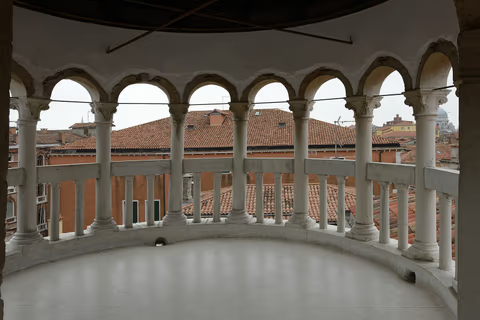
- Scala Contarini del Bovolo — 7 minutes towards the Rialto: the most photographed spiral staircase in Venice, cheap ticket, short queue.
- Palazzo Barbarigo Minotto — 6 minutes, behind Santa Maria del Giglio: home of the travelling opera of Musica a Palazzo.
- Gallerie dell'Accademia — 8 minutes, over the bridge: the great Venetian painters, from Bellini to Tiepolo.
Who it's for and who can skip it
The Music Museum in Venice works for three kinds of visitor. People who play a stringed instrument and find a density of technical detail no general museum offers. People with half an hour spare near St Mark's who do not want to spend it in a queue. People weighing up the evening concert who want to see what they are buying.
It does not work as a destination: you cannot build an afternoon around it, and anyone looking for an interactive museum for children will find little to do. Taken for what it is — a well-kept specialist collection, free, in a neoclassical church on the walk between La Fenice and the Accademia — it is one of the best-spent stops in the San Marco sestiere, the district it belongs to.