Which ticket to choose
Palazzo Pisani: Venice's Highest Rooftop Terrace
from €20
Best for:Anyone who wants the widest view in the city, inside a palace you cannot otherwise see
- Monumental courtyards
- Ballroom
- Concert hall
- Terrace at 31 metres
- Guide in Italian or English
Music Museum & Baroque Concert
from €42.50
Best for:Anyone who wants live music and historic instruments in one evening
- Interpreti Veneziani concert (1.5 hours)
- Music Museum
- Digital audio guide to the city
St. Mark's Campanile: Entry Ticket
from €25
Best for:Anyone who would rather not climb: there is a lift
- Entry to the Campanile
- Digital audio guide
Palazzo Contarini del Bovolo: Entry Ticket
from €10
Best for:A rooftop view at the lowest price, with no advance booking
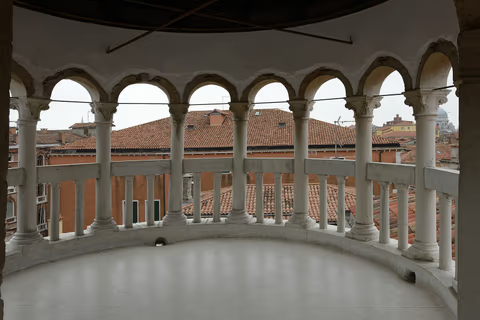
- Bovolo staircase
- Tintoretto room
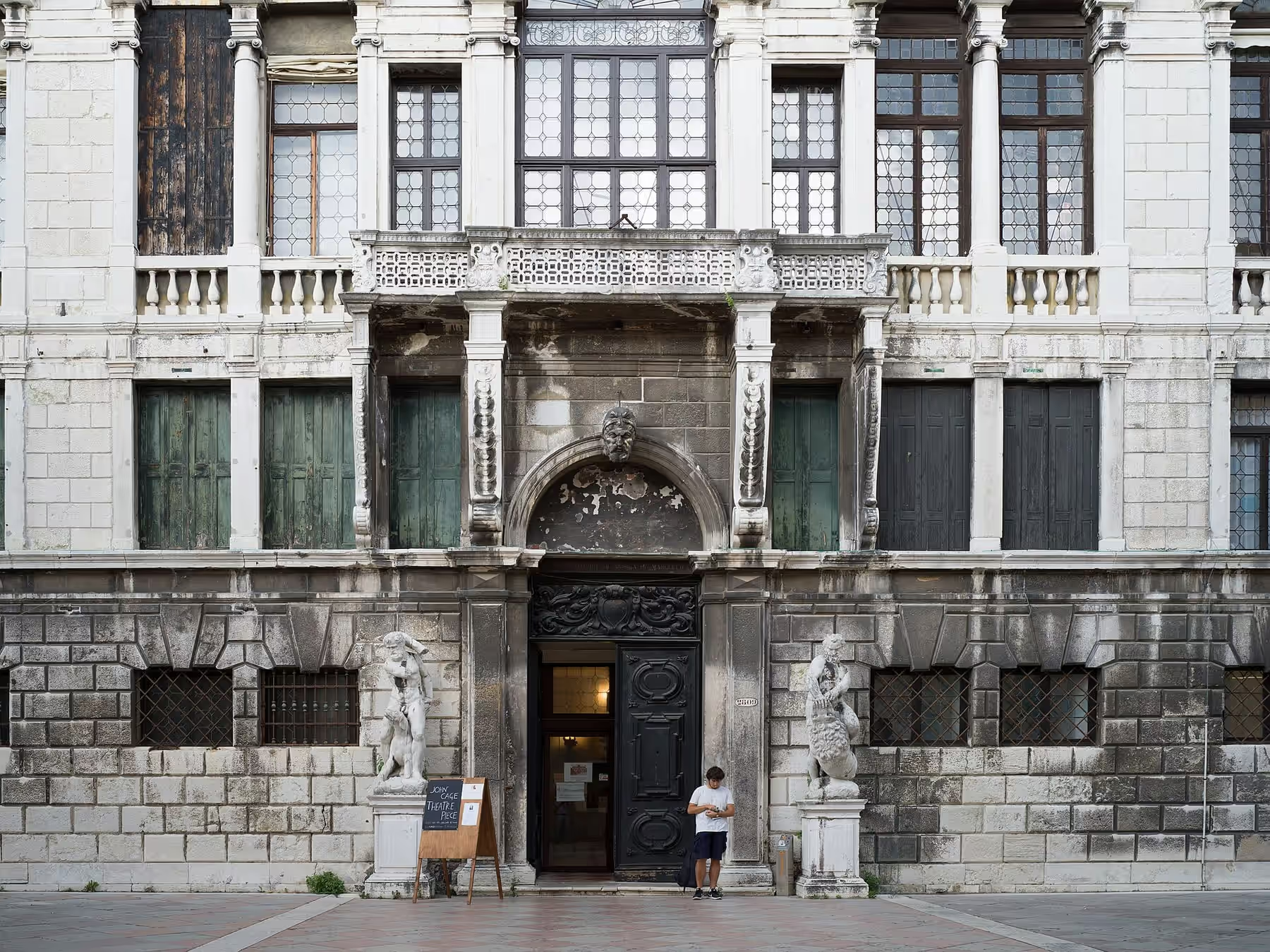
Palazzo Pisani Venice is the largest private palace in the city after the Doge's Palace, home of the Benedetto Marcello Conservatory, and it has one feature no printed guidebook explains properly: a terrace on the roof, 31 metres up, billed as the highest rooftop terrace in Venice. It is not a museum and you cannot wander in. The only way up is a guided tour at a fixed time, from €20.
Tickets: what you are actually buying
The guided tour is the only way in. The €20 ticket covers the two eighteenth-century courtyards, the ballroom, the concert hall and the terrace, with a guide in Italian or English, for about an hour, in groups of up to thirty. At 4.9 stars from 417 reviews, Palazzo Pisani: Venice's Highest Rooftop Terrace is one of the best-rated Venetian products in the catalogue, which is rare for a capacity-limited experience.
What is not included: entry to the Music Museum. If historic instruments interest you, there is a separate package at €42.50 pairing a ninety-minute concert by the Interpreti Veneziani, the Music Museum and its roughly two hundred historic instruments, and a digital audio guide to the city.
The terrace ticket can be cancelled up to two hours before your time slot; the concert package cannot be cancelled at all. Bear that in mind if the forecast is uncertain: the terrace is open to the sky, and in driving rain the view is wasted.
Book with instant confirmation

Palazzo Pisani terrace or St Mark's Campanile?
This is the real question for anyone landing on this page. The two are not substitutes.
| Palazzo Pisani | St Mark's Campanile | Bovolo staircase | |
|---|---|---|---|
| Price from | €20 | €25 | €10 |
| Height | 31 m | about 99 m | about 26 m |
| Climb | 195 steps | lift | spiral staircase |
| Access | guided tour only | open, with a queue | open |
| Duration | 1 hour | 40 minutes | 30 minutes |
| Booking | compulsory | advisable | not needed |
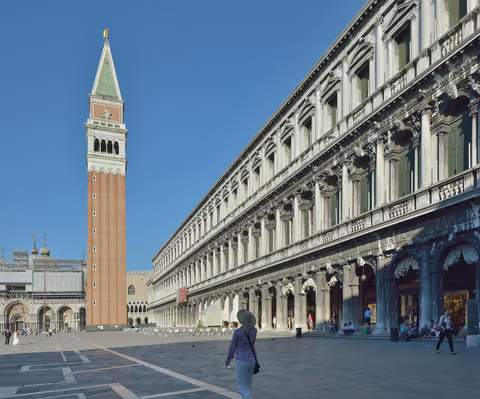
The Campanile gives you the postcard: square, basin, islands, with a lift that solves everything. It also has long queues and a crowded platform. The full comparison is on our St Mark's Campanile page.
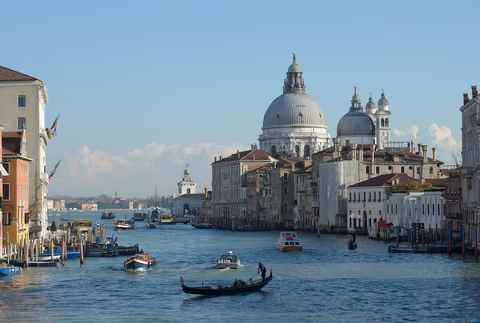
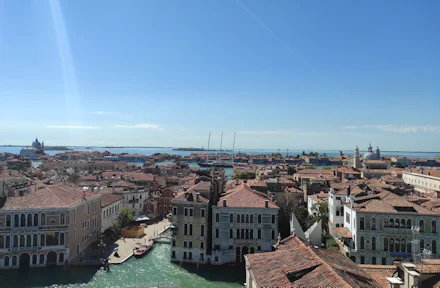
Palazzo Pisani gives you something else. You are at the height of the roof terraces and the chimneys, reading the geometry of the red tiles, with the domes of Santa Maria della Salute and the bell tower of San Giorgio Maggiore on different planes, in a group of thirty at most. And you are inside a building you cannot see in any other way.
The Scala Contarini del Bovolo stays the budget option: ten euros, no booking, a lower but very pleasant view.
If you can only do one and you have already seen Venice from above, take Palazzo Pisani. If it is your first trip and time is short, take the Campanile.
What you see on the tour
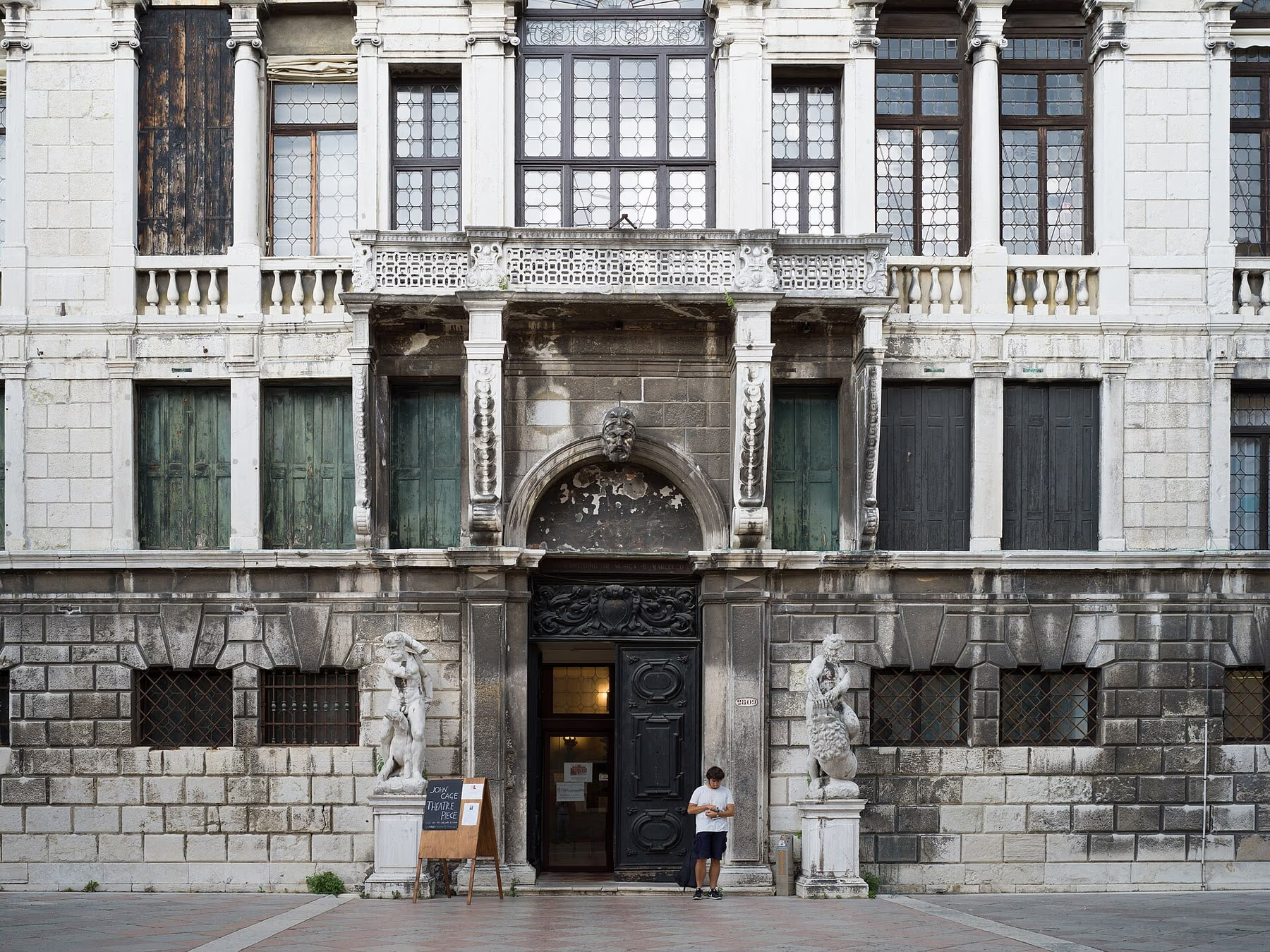
The courtyards. The palace was begun for the Pisani family in 1614–15 and enlarged in the eighteenth century to a design by Girolamo Frigimelica: the structure of two stacked courtyards linked by loggias is the most surprising piece of architecture in the building, and none of it shows from the street.
The ballroom and the concert hall. Plasterwork, decoration and the state staircase all tell you how rich a family had to be to give the Republic a doge, Alvise Pisani. The concert hall is now used for recitals and exams: you may well cross it while somebody is tuning a piano.
The film sets. The tour passes through the rooms used in Casino Royale, Mission: Impossible - Dead Reckoning and A Haunting in Venice. Travelling with teenagers, that is the argument that makes 195 steps acceptable.
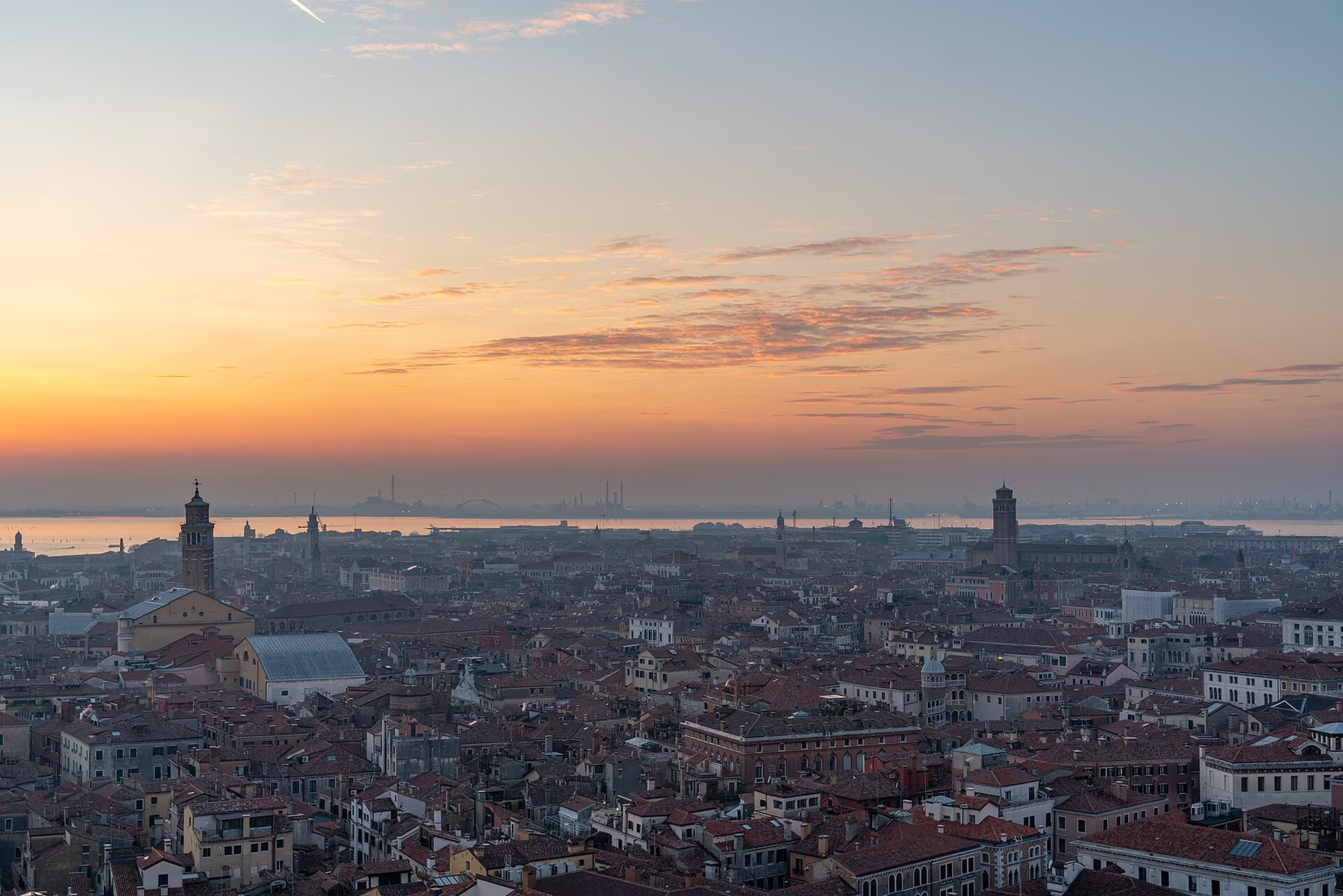
The terrace. A last narrow flight of stairs, and then you are outside. The view takes in the historic centre and much of the lagoon: the St Mark's basin to the south, the islands to the north, and the Dolomites on clear winter days.
Why such a large palace at Santo Stefano
The question comes naturally once you are standing in front of the facade: how does a building this size fit into a sestiere of narrow calli, the alleys that pass for streets here. The Pisani of Santo Stefano were among the richest families in the Republic, bankers and landowners, and they bought up the houses around them one by one to expand. The plan was ambitious enough that the Senate blocked the extension towards the campo: in truth the palace was never finished as designed.
The Benedetto Marcello Conservatory has occupied the building since 1876, and has kept it a place of study rather than turning it into a museum. That is why the opening times are so restricted and why you are always accompanied: you are walking down corridors where lessons are going on.
Do not confuse this building with Palazzo Pisani Moretta, on the Grand Canal in San Polo, which opens only for private events and gala dinners. They are two different palaces belonging to the same family, and the confusion costs people their bookings every week.
Access rules and accessibility
There is only one critical point: 195 steps and no lift. The climb is broken up by the guide's stops, but the last flight is narrow and steep. The tour is not suitable if you have mobility or heart problems or a strong fear of heights, and the product is listed as not wheelchair accessible.
Space on the terrace is limited: you stand, in turns, behind a parapet. Large rucksacks, tripods and pushchairs stay downstairs. Personal photography is fine; professional filming and drones need the conservatory's permission.
When to go
The days. Guided tours run on a few fixed days each week, usually Friday and Saturday, with only a handful of departures a day. The conservatory is a working institution: during exam sessions, concerts and academic closures the calendar disappears. Check the available dates when you book, and do not count on a last-minute visit.
The best hour for photographs. The last afternoon departure, when the light comes in low from the west and the roofs take colour. At midday in summer the terrace is exposed and shadeless: bring a hat and water.
The season. Winter and the shoulder seasons give the cleanest air and the best visibility towards the mainland. In summer the horizon is often milky with humidity off the lagoon.
The weather. In heavy rain or high wind the climb to the terrace can be suspended for safety. If that slot is your only one and the forecast is bad, cancel at least two hours ahead.
How to save
- There is no cheaper terrace-only version. The price is the price of the guided tour: for a view under ten euros, look at the Bovolo staircase instead.
- Reductions for children and students need to be checked when you book: they are not standardised the way they are in the civic museums.
- The concert package is only worth it if the concert genuinely appeals. Bought separately, a baroque concert in Venice costs on average €30 to €40, so the saving is real but modest.
- The Music Museum in the church of San Maurizio, five minutes away, is free and holds a collection of historic instruments. It is the cheapest way to find out whether the subject grabs you.
- The mistake that costs money: booking the terrace and Teatro La Fenice for the same hour. They are eight minutes apart, but both admit you at a set time: leave at least two hours between them.
Getting there
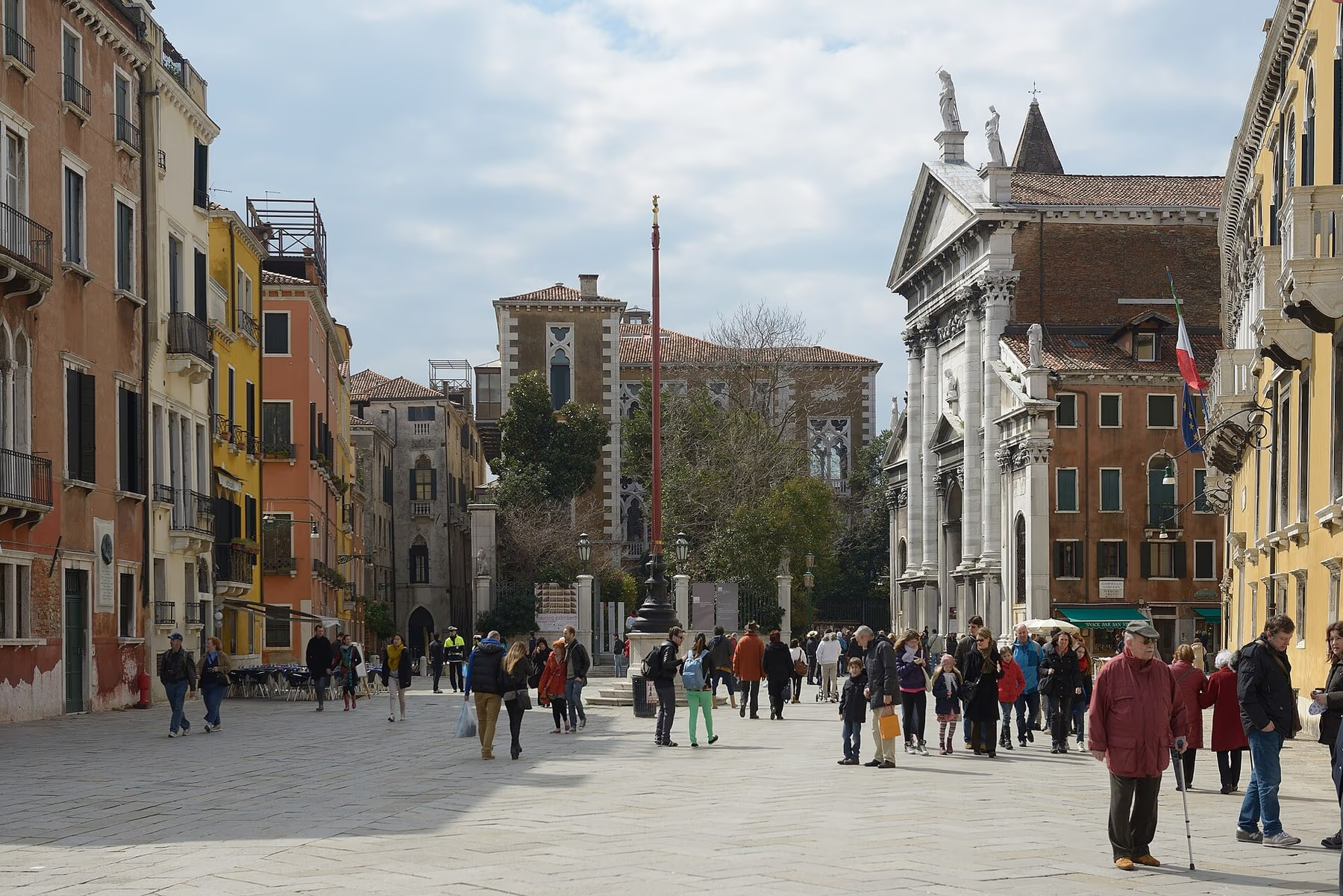
Address: Campiello Pisani 1910, San Marco 2810, 30124 Venice. The campiello opens off the south side of Campo Santo Stefano: look behind the church for a dead end that most people walk straight past.
Vaporetto (the water bus). The handiest stop is Accademia (lines 1 and 2), 5 minutes on foot: cross the Accademia bridge, walk into Campo Santo Stefano and turn right. Otherwise Sant'Angelo (line 1), 6 minutes, or Santa Maria del Giglio (line 1), 7 minutes. For the right ACTV ticket — ACTV runs the city's public transport — see our guide to vaporetto tickets.
On foot. From St Mark's Square 10 minutes by way of Calle Larga XXII Marzo and Campo Santo Stefano. From Rialto 12 minutes. From Santa Lucia station about 30 minutes, which is a long way to drag a wheeled case over bridges.
Arrive 10 minutes before the time on your ticket. The group leaves on time and, since this is a university building with a porter's lodge, nobody is let in once the tour has started.
What else is nearby
- Santo Stefano church, 2 minutes: a ship's-keel ceiling and a leaning bell tower, one of the most tilted in the city.
- Music Museum in the deconsecrated church of San Maurizio, 4 minutes: free, with violins and baroque instruments.
- Teatro La Fenice, 8 minutes: a visit with an audio guide, booked separately.
- The Accademia bridge, 3 minutes: the view down the Grand Canal to the Salute, the most reproduced photograph in Venice after St Mark's Square.
- Scala Contarini del Bovolo, 7 minutes: for another angle, if the terrace left you wanting one.
Palazzo Pisani Venice works best as the single fixed point of a half day rather than something wedged between two museums: an hour on the tour, then a coffee in Campo Santo Stefano and the walk down to the Accademia. To compare prices and booking rules across the rest of the city, start from our Venice tickets page.